
☰
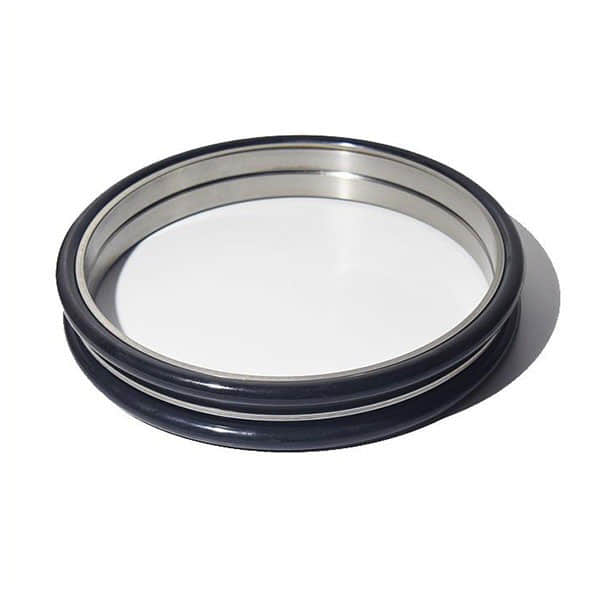
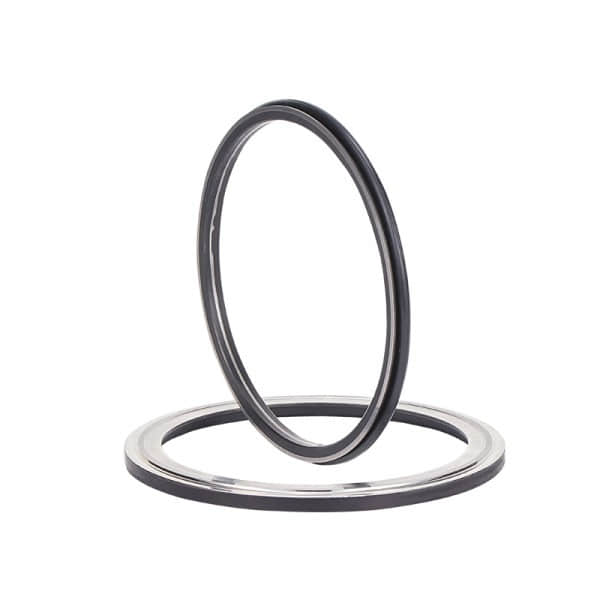
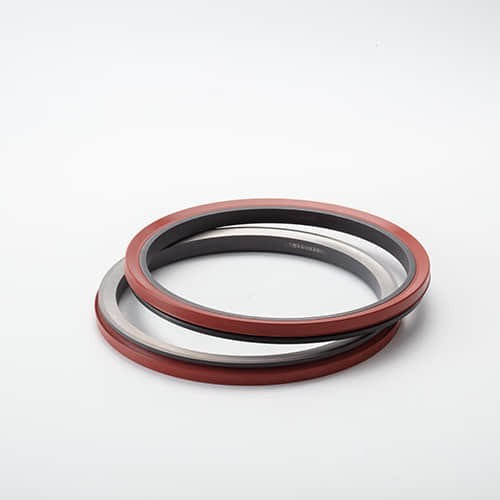
Type DF mechanical face seal with diamond-profile elastomer — the compact-axial alternative to standard DO duo-cone seals.

Type DF uses a diamond, trapezoidal or double-cone section elastomer instead of the circular O-ring on Type DO. This is common in Komatsu-type and similar OEM structures. The difference is not cosmetic: DF changes the force path, positioning and compression behaviour between elastomer, metal ring and seal house. Two identical alloy rings still meet on lapped faces, but the housing contour, assembly direction and face-pressure curve are DF-specific.
DF suits designs with defined seal-house geometry and often tighter axial packaging. Because the elastomer cross-section is directional, wrong substitution carries higher risk than a simple size mismatch — a DO group must never be pressed into a DF cavity (or the reverse). HuaTong manufactures DF rings on the same 15Cr3Mo casting, heat-treatment and lapping routes as DO, with seal-house angles, groove depth and elastomer compound matched to the OEM drawing.
| Profile | Type DF — diamond / trapezoidal elastomer loaded mechanical face seal |
|---|---|
| Elastic element | Shaped toric ring (not circular O-ring); cross-section has directional faces |
| Force path | Geometry contacts transfer axial and radial load more directionally than DO O-ring compression |
| Seal-house demand | Cavity profile, angle, width and height must match DF elastomer — higher machining accuracy than many DO seats |
| Typical OEM context | Komatsu-type crawlers and similar machines where DF structure is specified on the drawing |
| Substitution risk | DO in DF housing (or DF in DO) may physically fit but face pressure and compensation become uncontrolled |
Housing design, installation and DF-vs-DO selection criteria. Scroll inside the bordered panel.
| Assembly composition | 2 metal seal rings + 2 diamond-profile elastomer rings = 1 complete DF floating seal group |
|---|---|
| Working principle | Elastomer centers each ring in its housing and loads the lapped faces axially; one ring rotates, one static; oil film forms on the contact band |
| Housing bore finish | Seal pocket machined surface typically Ra 3.0–6.0 µm; housing edges rounded because elastomer is oversize to bore |
| Housing taper geometry | Tapered cones in housing and at ring O.D. centre the seal; taper grade increases with bore depth |
| Axial gap (S) | Set per seal size and speed; larger gap reduces face load and heat at high sliding speed; verify on bench for critical duty |
| DF vs. DO — radial space | DO generally needs less radial clearance; DF may need slightly more radial room in some catalog sizes |
| DF vs. DO — shock/contamination | DO O-ring profile tolerates more float and misalignment under heavy shock; DF preferred when geometry, not shock, is the constraint |
| Ring alloy | 15Cr3Mo-class high-chrome cast iron; HRC 65–72 after heat treatment |
| Face lapping | Twin-face lapping; flatness and Ra controlled per routing card (HuaTong target Ra ≤ 0.2 µm class) |
| Contact band | Running band approx. 0.2–0.5 mm wide; migrates inward as faces wear; elastomer releases stored compression to compensate |
| Elastomer compounds | NBR (standard), HNBR (heat/oil), FKM/Viton (chemical and elevated temperature) |
| Lubrication | Oil bath mandatory for speed duty; oil fills wedge gap and cools faces; grease only at reduced speed with validated design |
| Installation sequence | 1) Seat diamond ring fully on metal ring 2) Clean in solvent, dry 3) Press half-set with install tool on ring I.D. only 4) Verify symmetric seating 5) Oil faces and mate halves slowly (~2 mm/s) |
| Installation caution | Never contact lapped faces with tools; excess grease during install can make elastomer slide on ramps instead of roll, causing leaks |
| Rebuild rule | Replace both metal rings and both elastomers as a matched set; do not mix worn and new faces |
| OEM cross-reference | Submit machine model, housing drawing or sample for DF/DO interchange review |
DF is selected because the OEM seal house and elastomer section are DF, not because the machine works in a cleaner environment than DO applications.
DF groups specified on OEM drawings for travel motors where the seal house was designed around shaped elastomer compression paths.
Carrier rollers and idlers with accurate bore geometry where directional elastomer faces control metal-ring position under vibration.
Hubs with restricted axial depth where DF section height fits the cavity when DO envelope cannot be accommodated without redesign.
Send your housing drawing — we will confirm profile, axial gap S and elastomer compound.
Contact us